Field notes
Photographing Water From First Light to Last
One subject, one stretch of coast, thirteen hours, and a set of frames that are only interesting because the water was never doing the same thing twice.
January 26, 2026 / One bay, all day / Any / 8 min
Filed under
Field notes
Written by
Marin Krueger
Published
January 26, 2026
An independent journal with nothing for sale. No booking is taken here, no money changes hands, and no carrier, hotel group or reservation service has any connection to what appears on these pages.
The most useful working day I have had in years involved one bay, no driving after seven in the morning, and a total walking distance I could have covered in half an hour if I had been going anywhere.
The idea was not original and I would recommend it to anyone. Pick a single piece of coast. Arrive before first light. Stay until after the last of it. Do not go anywhere else. The subject is water and the only variable you allow yourself is time.
What I want to write down is what actually changes hour by hour, because the surprise was not the dawn or the dusk. Those are the hours everybody plans for. The surprise was the middle of the day, which I had spent fifteen years treating as dead time.
Before light: the quietest and the hardest
I was in place forty minutes before sunrise with nothing to see and a strong suspicion I had wasted an alarm.
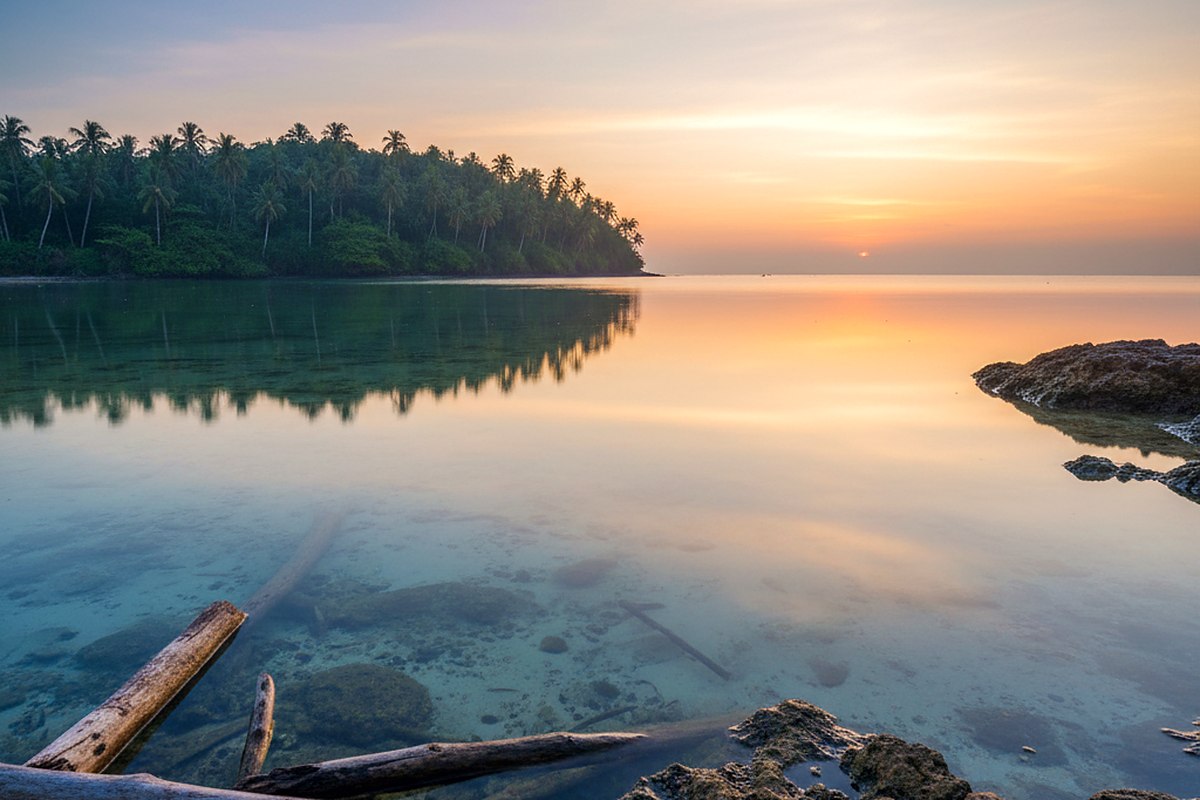
That period is difficult because there is not enough light to work quickly and nothing is happening in any obvious way. It is also the only time the water is likely to be genuinely still, because on most coasts the wind has not started. Still water is not interesting in itself. Still water holding an upside down headland, with a band of colour in the sky that has not arrived on the land yet, is a picture you cannot make at any other hour.
The practical notes are dull and they matter. Set up in the dark and compose by feel, because at the moment the light arrives you will not want to be looking for a tripod plate. Expect the first usable frames roughly twenty minutes before the sun clears the horizon, not after. Expect to be cold in a place where being cold sounds impossible.
The first two hours: the ones everybody wants
Then the sun comes and for about ninety minutes everything is easy, which is precisely the problem with it.
Low light across water gives you texture on the surface, colour in the spray, and long shadows that separate one rock from the next. Nearly anything works. That is the hour that fills portfolios, and the frames from it are usually the ones I keep and least often the ones I care about, because everybody who was on that beach that morning came home with a version of them.
The one thing I now do differently in this window is turn around. The light landing on the land behind me is the same light, and there are usually about four minutes when the top of a ridge or the face of a cliff has it and nothing else does. Almost nobody is pointing that way.
Mid morning to noon: stop looking out, start looking down
Between about nine and eleven the light goes hard and high and the sea stops being a landscape. This is where I used to leave.
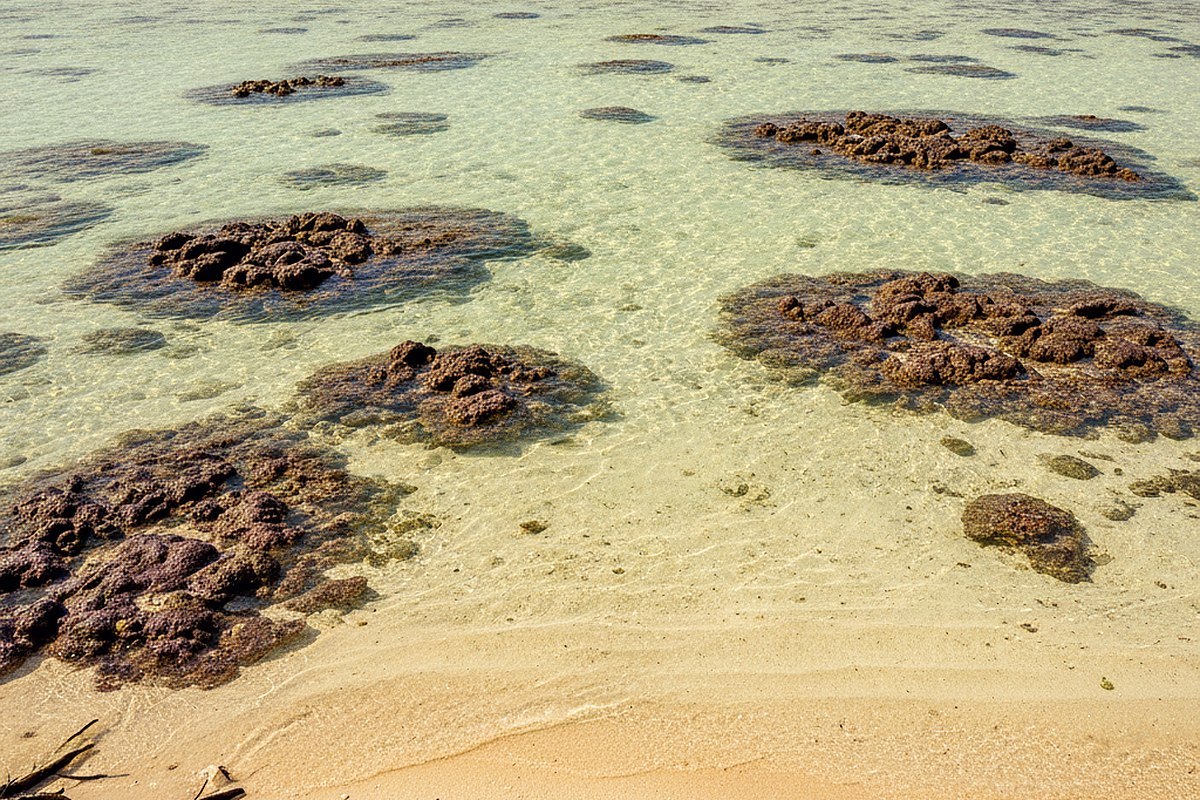
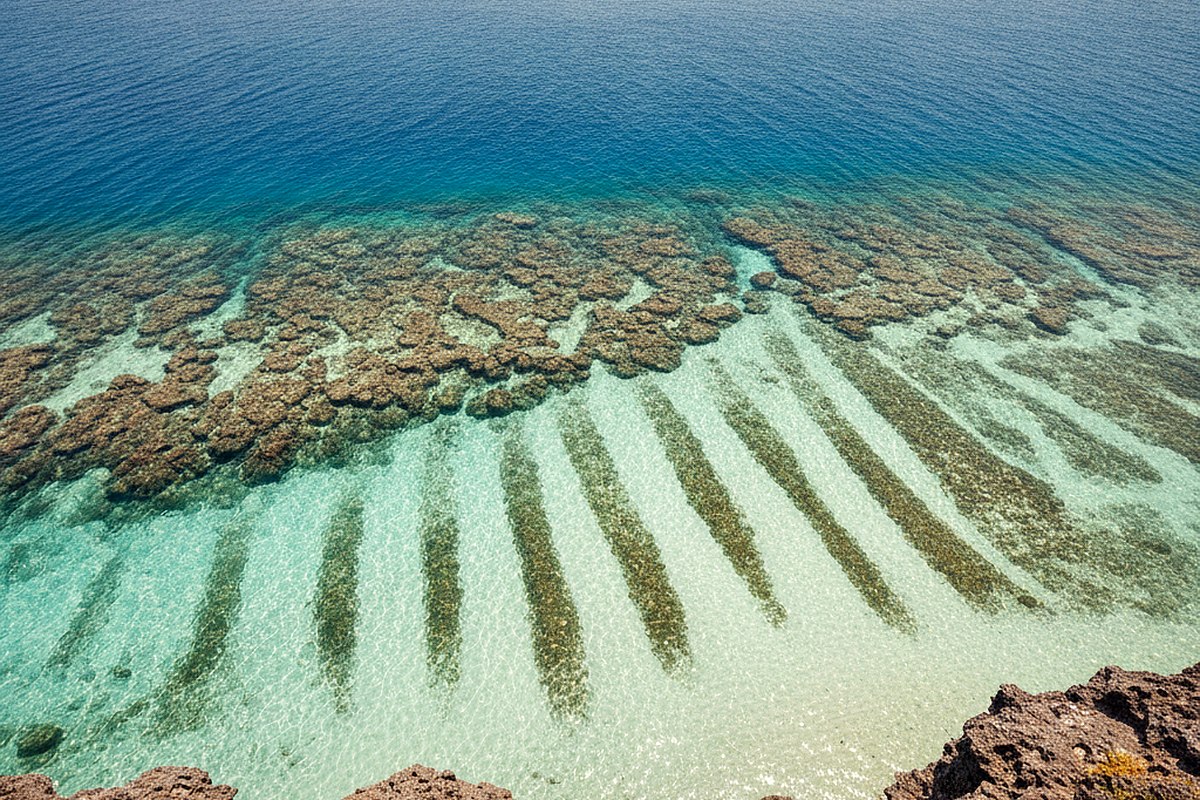
What I do now is look down. High sun is the only condition in which water becomes transparent to a camera and the shape of the bottom shows through. From a headland at eleven in the morning, a bay reads as bands: pale sand, the darker rough of reef, the sudden line where it drops, and a channel cut through the middle in a completely different blue. You cannot see any of that at dawn, when the whole surface is a mirror.
Overhead sun also gives you the only clean look at what surf actually does. In flat hard light the foam is white, the water is legible, and the pattern of a wave breaking over an uneven bottom can be seen rather than guessed at. I made more frames I kept between ten and noon than in the golden hour, and none of them look like typical coastal photographs, which is the point.
The long afternoon, which is the real test
Between about one and four the coast is at its least photogenic and the temptation to go somewhere is at its strongest. I have failed this test many times.
What worked was giving myself a task rather than a subject. Photograph one rock as the tide leaves it. Make twenty frames of the same three feet of water and keep only the one where the shape is right. Wait for the wind to do something. The task keeps you in place, and staying in place is the entire method.
The other thing that happens in the afternoon is that the wind arrives, usually onshore, and the water changes character completely. A morning bay that was glass becomes a hammered surface with spray coming off the tops of things. That is the condition for a whole different set of pictures, and it only exists because you stayed.
Last light and after
The evening reverses the morning but is not its mirror. Wind usually drops before the light goes, which means you get the calm surface and the colour at the same time, which almost never happens at dawn.
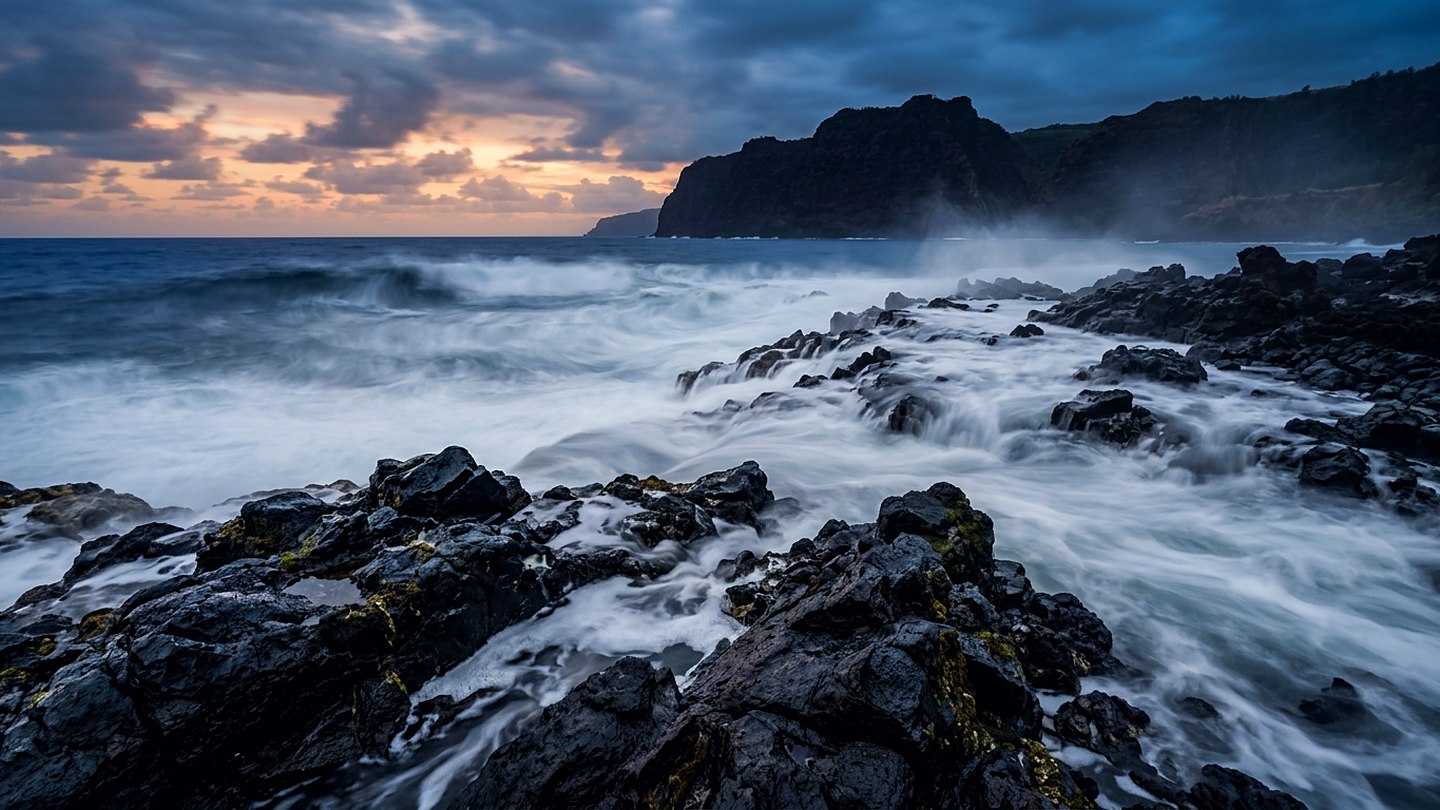
The frames I like best from this day were made after the sun was down, in the twenty five minutes when the sky still has light in it and the water has gone to a soft blue that does not exist at any other time. Exposures get long enough that swell turns to smoke over rock, and that effect goes from subtle to overdone across about four minutes, so it is worth working fast and bracketing the time rather than the exposure.
Then it is dark, and the honest end to a day like this is to stand there for a while without the camera, listening to a bay you have been looking at for thirteen hours and now cannot see at all.
What I carried, and what I would leave
Less than I thought. One body, two lenses, a tripod, a lens cloth and a spare, water, food for the whole day, and a hat. The second cloth was not an indulgence: salt spray and fine mist coat the front element within minutes on any exposed coast and half my discarded frames from an earlier trip had a smear on them I did not spot at the time.
What I would leave behind is the extra lens I did not use, the filter set I touched once, and the idea that I needed to cover ground. On a day like this the equipment that matters is the chair you did not bring and the patience you did.
Why one place beats five
There is an arithmetic to this that took me too long to see. Five locations in a day means five arrivals, five parking situations, five walks in, and about forty minutes of actual photography at each one, always in the wrong light because the light does not schedule itself around a route.
One location means you are present for every state that place enters over an entire day, and coasts change state constantly. The bay I sat in that day was, over thirteen hours, a mirror, a hard blue plane, a transparent window onto a reef, a wind chopped mess, and finally a slow blue smoke. Five different places would have given me one of those each, at whatever hour I happened to turn up.
Since then I have done it perhaps a dozen times. It has never once been the day I expected, and it has never once been a wasted one.